
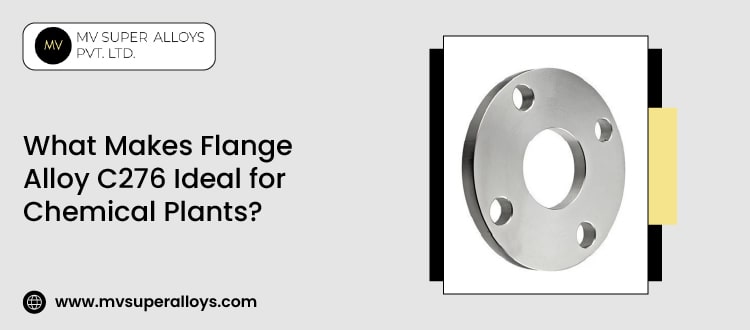
What Makes Flange Alloy C276 Ideal for Chemical Plants?
Does your business revolves around in or around chemical and petrochemical plants? If yes, then you will definitely know how extreme and unforgiving many process environments can be. Factors such as Highly corrosive acids, chlorides, mixed‑oxidising and reducing media, temperature swings, welding zones and dense piping networks contribute to putting loads of pressure on on flanges, valves and other critical equipment.
Hence you need to understand how to choose the right flange for your chemical plant. Now, among the many options available which you can choose from for usage in your piping system. One of the most ideal selections would be Nickel alloy C276 flanges or Flange Alloy C276 for your chemical plant.
We at MV Superalloys, a leading Hastelloy C276 flange Supplier in India offer you this blog explaining everything you need to know about Hastelloy C276 flange including Alloy C276 properties that belongs to the Nickel-Molybdenum-Chromium alloy flanges family.
What is Alloy C276 and what do its characteristics offer?
Alloy C276 is a nickel‑molybdenum‑chromium‑tungsten alloy (UNS N10276, Werkstoff No. 2.4819) created for resistance in harsh chemical environments.
Here’s a failure of what makes this alloy so working:
Chemical composition and solid‑solution resources.
It typically contains around 57 % nickel, 15‑17 % molybdenum, 14.5‑16.5 % chromium, plus tungsten, iron, cobalt, etc.
- Corrosion Items
The high nickel base and giant molybdenum/chromium additions give strong resistance to both oxidising and reducing environments.
-
Extraordinary corrosion resistance.
Alloy C276 is noted for resisting pitting, crevice corrosion and stress‑corrosion cracking—flat in chloride‑rich, wet‑gaseous or blended‑acid settings.
For case: it handles acids like sulphuric or hydrochloric, chlorine and chlorides, hypochlorite, and brine/sea water controls.
- Weldability, formability and fabrication capital.
Unlike some alloys that degrade in the weld heat‑affected zone, C276 is developed so that precipitation at grain‑limits is minimal, meaning welds maintain corrosion resistance.
The alloy can become forged, hot‑worked (typical hot‐forming range 870°C to 1230°C) and cold‑worked, forming it adjustable to flanges, fittings and hard geometries.
Corrosion Tools
- Mechanical/thermal traits that backup demanding service.
Some key physical and mechanical ideals: density ~8.9 g/cm³; expandable modulus ~205 GPa; stretching at break roughly 40‑56% depending on condition.
Over and above that, thermal development is adjustable (~11.2 µm/m‑K for 24‑93°C) generating it more stable under temperature fluctuations.
More, importantly, Alloy C276 offers the durability, corrosion‑toughness and accuracy that chemical‑plant service demands.
Why flanges created of Alloy C276 are ideal for chemical plants?
Now let’s target why choosing flanges produced from this alloy—such as forged, welded neck, slip‑on or blind flanges—makes sense in chemical plant piping systems. When a supplier like MV Superalloys advertises “Hastelloy C276 flange supplier” or “nickel alloy C276 flanges for chemical plants”, these are the credible upsides behind those keywords.
- Withstanding severely corrosive media
In chemical plants you often face combinations of offensive media: acids, chlorides, oxidisers, reducing business agents, merged phases (liquid/gas), hot brine, smooth sour gas environments. Alloy C276 is developed for right that—from long‑term immersion in strong acids to wet chlorine environments.
When your flange is the junction point in a piping operation handling chemical reaction products or waste streams, the flange material matters a lot. A flange in standard stainless steel may suffer pitting or cracking; one in C276 will perform far longer.
- Reliable sealing and integrity under pressure
Flanges must maintain leak‑free ties under pressure, temperature adjustments and sometimes vibration. C276’s capital (when solution treated) and weldability offer the needed structural integrity. Again, when exact to manufacturing standards like ASTM B564 / ASME SB564 and flange standards like ANSI/ASME B16.5/B16.47, you’re getting components that meet industrial pressure/size norms.
For model, a C276 flange in class 150 through class 2500 (for instance ½″‑60″ sizes) gives flexibility across pipeline sizes.
- Versatility in welding and fabrication
Because chemical plants often require on‑site welding, field modifications, or custom flanged bonds, it helps that C276 is fabricable. It can be used in the as‑welded condition for many services, meaning less need for post‑weld heat treatments that might slow construction or repair.
That means when a flange supplier lists “Alloy C276 flanges” and offers types such as weld‑neck, slip‑on, blind or lap‑joint, you’re skilled to specify the accurate style for your workflow needs.
- Longevity & lifecycle cost savings
While the upfront material cost of a nickel‑based alloy like C276 is higher than standard steel or low‑alloy alternatives, the extended life, reduced maintenance and fewer failures often justify the investment in chemical‑plant settings. Fewer flange replacements, less downtime, reduced risk of leaks or corrosion failure—each insert value.
- Meeting chemical‑plant standards and traceability
When you make a choice a supplier listing “ASTM B564 Alloy C276 flanges” or “UNS N10276 flanges”, you’re signalling that the material meets recognized international specifications. That means material traceability, approved chemistry and mechanical tests, and reception by significant plant constructors or agencies. For specimens, the standard covers “Forged or plate flanges” in Alloy C276.
Selecting the faultless supplier and specification for your needs:
When contacting a vendor (for instance MV Superalloys) and looking for “Hastelloy C276 flange supplier” or “nickel alloy C276 flanges for chemical plants”, here are some key questions and specification points to confirm:
Confirm the degree: UNS N10276 / Alloy C276 / Werkstoff 2.4819:
Ensure the flange meets the right specification: ASTM B564 / ASME SB564 for forged/plate flanges in C276.
- Validate flange type, size and pressure class: For representation slip‑on, weld‑neck, blind, lap‑joint; sizes from ½″ to 48″ (or balanced 60″) and classes from 150 # to 2500 #.
- Confirm that the material is solution heat‑treated and empowered for corrosion‑service (largely for chemical use) and that welding/fabrication instructions position.
- Confirm the supplier has understanding of chemical‑plant service (acid, chloride, oxidising media) and can substitute documentation (mill test certs, forging records, fluoroscopic testing etc) which is ordinary in critical installations.
- Consider logistics and regional usability: For Indian plants (Mumbai region etc) having a local vendor like MV Superalloys simplifies turnaround, inspection and support.
Credible‑world chemical‑plant Uses:
- In chemical and petrochemical processing you’ll find C276 flanges in:
- Reactors and vessels handling hot acids (e.g., sulphuric, hydrochloric, formic, acetic).
- Piping that sees merged oxidising & reducing media including chlorides or wet chlorine gas.
- Scrubbers and pollution‑control equipment (flue‑gas desulphurisation) where high chloride/acid condensate attacks opposite alloys.
- Special Metals
- Waste‑water or effluent lines with chlorides or halides, where crevice/pitting resistance is critical.
- Sandmeyer Steel Company
- In every single case, having flanges of Alloy C276 extends service life, reduces unscheduled downtime, and mitigates safety/leak‑risk from flange failures.
Finally, if you require flange components that are ideally suited for the hostile and corrosive environments then, we at MV Superalloys a top Hastelloy C276 flange Supplier in India, recommend that you use Nickel alloy C276 flanges for chemical plants.
More importantly, if you are seeking a top Flange Alloy C276 Manufacturer in India then, you need to ‘Contact Us’ MV Superalloys today to get an affordable ASTM B564 Alloy C276 flanges Price in India today.
About Post Author
