
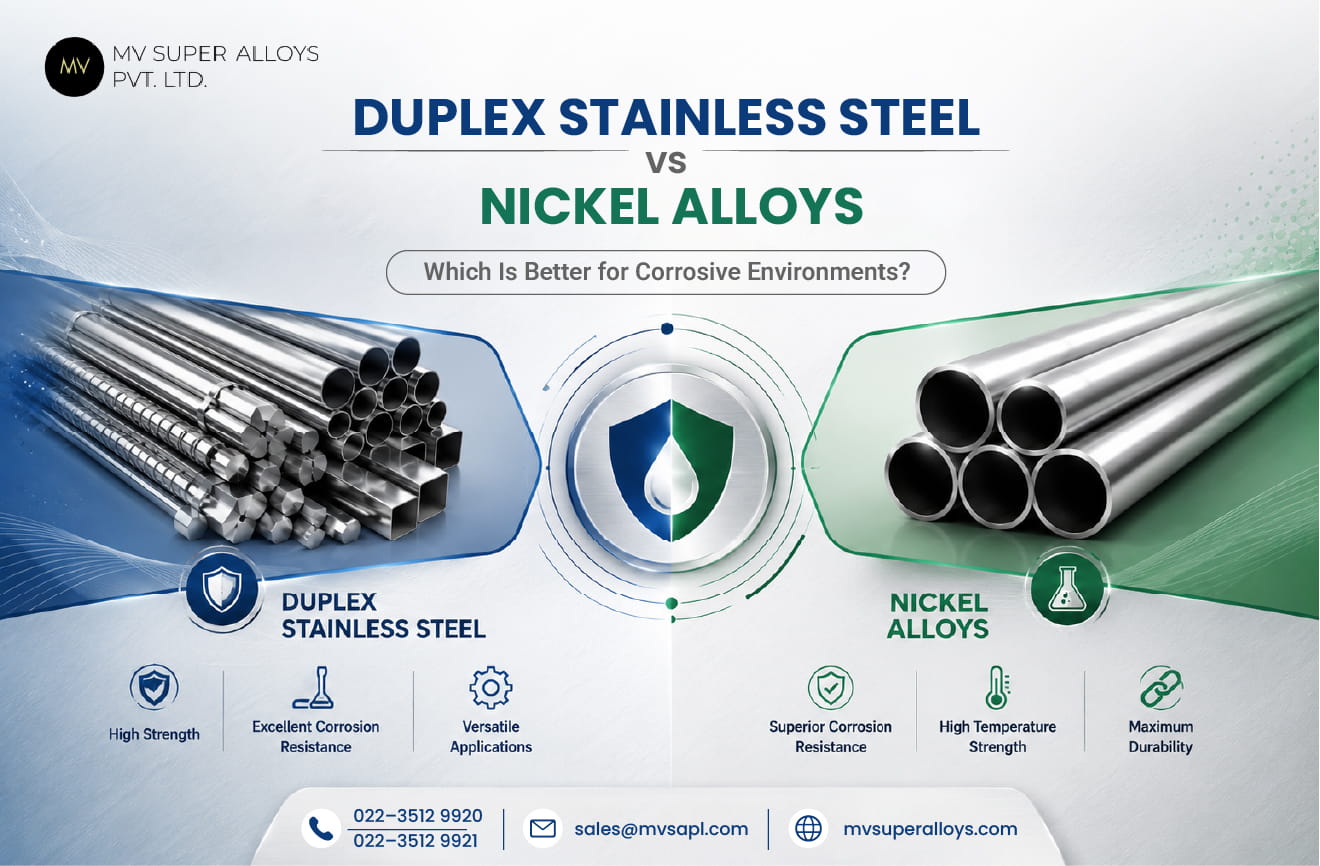
Duplex Stainless Steel vs Nickel Alloys: Which Is Better for Corrosive Environments?
For many industries like chemical processing, offshore oil & gas, marine engineering and power generation, choosing the right material for corrosive conditions is fundamental to the safety, durability and cost-effectiveness of the application. Duplex Stainless Steel and Nickel Alloys are two of the most trusted materials for aggressive conditions. They are both highly corrosion resistant, but vary widely in strength, price, heat resistance, and suitability for use.
MV Superalloys is one of the top Duplex Stainless Steel Exporters in India, a reliable supplier of the Nickel Alloys Used in Industry, offering high quality corrosion resistant materials for industrial applications. The comparison of duplex stainless steel and nickel alloys can assist industries in making informed investments for sustained performance among best material for corrosive environments
The Basic Facts of Duplex Stainless Steel:
Duplex SS is a family of stainless steels with a balanced microstructure of austenitic and ferritic phases. The dual structure offers high strength and high corrosion resistance, superior to those of conventional stainless steels.
Popular grades include:
- Duplex 2205
- Super Duplex 2507
- Zeron 100
- SAF 2205
The high resistance to chloride stress corrosion cracking and pitting makes duplex stainless steels suitable for use in seawater systems, chemical tanks, pipelines, pressure vessels and offshore structures.
Nickel Alloys: What Are They?
Nickel alloys are high-performance materials that are based on nickel and also contain chromium, molybdenum, iron and other elements. They are specially formulated to resist extremely corrosive environments, such as acids, high temperatures and aggressive chemicals.
The following are common nickel alloy grades:
- Inconel 625
- Inconel 718
- Hastelloy C276
- Incoloy 825
- Monel 400
The nickel alloys are commonly employed in the field of aerospace, nuclear plants, chemical reactors, marine engineering, gas turbines, etc., due to their excellent resistance to oxidation, stress corrosion cracking and high temperatures.
Corrosion Resistance Comparison
Duplex Stainless Steel and Nickel Alloys are two materials that must be compared with respect to corrosion resistance.
Duplex Stainless Steel
In chloride environments like seawater and salt manufacturing plants, duplex grades show outstanding service behaviour. They are high in chromium and molybdenum, which helps to resist:
- Pitting corrosion
- Crevice corrosion
- Stress corrosion cracking
- Chloride attack
Super Duplex grades especially offer excellent performance in marine environments.
Nickel Alloys
Nickel alloys are more resistant than most stainless steels in severe acidic and high-temperature environments. They are ideal for:
- Sulfuric acid applications
- Hydrochloric acid processing
- High-temperature oxidation
- Reducing chemical environments
Nickel alloys are stable even when exposed to extremely high temperatures and chemical stress.
Which Performs Better?
For seawater and chloride exposure: Duplex Stainless Steel is usually adequate and economical.
When high acid or high temperature applications are required: Nickel Alloys are the best option.
Strength and Mechanical Performance
Compared with traditional austenitic stainless steels, duplex stainless steel has almost twice the yield strength.
Benefits include:
- Higher load-bearing capacity
- Reduced wall thickness
- Lower structural weight
- Better fatigue resistance
Nickel alloys are also known for their excellent mechanical properties, particularly at high temperatures. They do not weaken in extremely high temperatures as stainless steels do.
Where high pressure pipelines or structural systems are involved, the use of duplex stainless steel can be very economical because of its high-strength to lightweight ratio.
Temperature Resistance
Nickel alloys offer numerous benefits, such as resistance to extreme temperatures.
Nickel alloys are capable of satisfactory performance in furnace components, heat exchangers and gas turbines where duplex stainless steels cannot be used for high temperature applications.
Duplex stainless steel is good for use in moderate temperatures, but may reduce toughness at high-temperature for extended periods.
Therefore:
Moderate temperature + corrosive = Duplex Stainless Steel
Nickel Alloys are the result of extreme heat + aggressive chemicals.
Cost Comparison
The cost of a material can frequently be a selection criterion in industry.
Duplex Stainless Steel
Duplex grades do not have as high a nickel content as nickel alloys, thus reducing the cost. They are also very strong, which means that they can be used in thinner sections, thereby using less material.
Advantages include:
- Reduced start-up expenses for materials
- Reduced fabrication weight
- Lower lifecycle costs
- Excellent resistance to corrosion in most industrial applications
- Nickel Alloys
The high content of Ni and Mo makes nickel alloys more costly. Their durability, though, in very harsh applications can make them a worthwhile purchase.
Nickel alloys can lower maintenance and replacement costs in the long run for applications with severe acids and high temperatures.
Fabrication and Weldability
Duplex stainless steel is much more readily machined and fabricated than nickel alloys.
Nickel alloys require:
- Specialized machining tools
- Controlled welding procedures
- Skilled fabrication techniques
This may make manufacturing more complicated and expensive.
A variety of uses for Duplex Stainless Steel.
It is a renowned Duplex Stainless Steel Exporter in India and offers Duplex products to industries like:
- Offshore oil & gas
- Chemical processing
- Marine engineering
- Desalination plants
- Heat exchangers
- Pressure vessels
- Pulp & paper industries
Duplex stainless steel is generally regarded as the most suitable material for corrosive environments where the presence of chlorides and sea water is a problem.
Nickel Alloys are used and have been used in a variety of applications.
MV Superalloys is a trusted Nickel Alloys Supplier, offering high performance nickel alloys for the following applications:
- Aerospace systems
- Nuclear reactors
- Acid processing plants
- Gas turbines
- Petrochemical refineries
- High-temperature reactors
- Power generation facilitie
Nickel alloys are unsurpassed in very corrosive and high-temperature environments.
The final verdict on the choice of materials:
The answer is no – the best material will depend on the environment in which it is to be used.
Use Duplex Stainless Steel when:
- Excellent chloride corrosion resistance
- High mechanical strength
- Lower material cost
- Lightweight construction
- The durability of offshore and marine materials.
Duplex stainless steels are a compromise in performance and cost, providing the best combination for many industries. But in some cases, when the operating conditions are very severe, nickel alloys are unmatched in terms of protection and reliability.
MV Superalloys, a trusted Duplex Stainless Steel Exporter in India and experienced Nickel Alloys Supplier, provides high quality corrosion resistant materials as per industry requirements.
If you are looking to buy Premium Quality Duplex Stainless Steel and Nickel Alloys at an affordable Duplex Stainless Steel and Nickel Alloys Price in India then you need to ‘Get in Touch’ with us at MV Superalloys.
FAQ
1. Which is the best material for corrosive environments?
The best material for corrosive environments depends on the application. Duplex stainless steel works exceptionally well in chloride-rich and marine conditions, while nickel alloys are better for acidic and high-temperature environments.
2. Why is duplex stainless steel preferred in offshore industries?
Duplex stainless steel provides excellent resistance to chloride stress corrosion cracking, high mechanical strength, and lower lifecycle costs, making it ideal for offshore oil & gas applications.
3. Are nickel alloys more corrosion resistant than duplex stainless steel?
Yes, nickel alloys generally offer superior corrosion resistance in highly aggressive acids and extreme temperatures compared to duplex stainless steel.
4. Is duplex stainless steel cheaper than nickel alloys?
Yes, duplex stainless steel is usually more economical because it contains lower nickel content and provides higher strength, reducing material usage.
5. Why choose MV Superalloys as a Duplex Stainless Steel Exporter in India?
MV Superalloys offers high-quality corrosion-resistant materials, competitive pricing, global export standards, and reliable supply solutions for industrial applications worldwide.
About Post Author
