
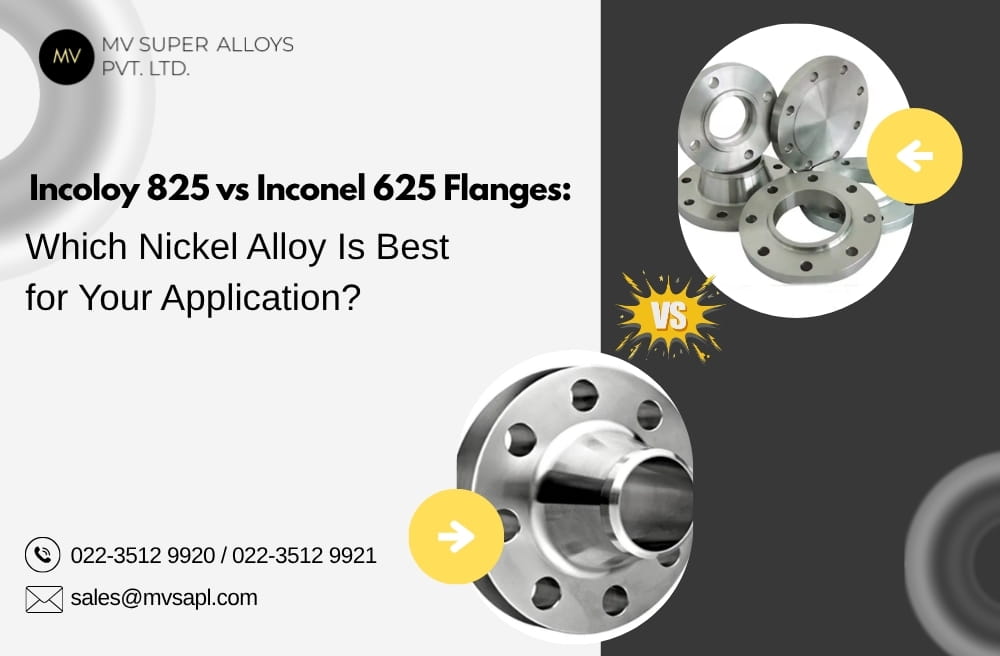
Incoloy 825 vs Inconel 625 Flanges: Which Nickel Alloy Is Best for Your Application?
In chemical processing, oil and gas, marine engineering and power generation industries among others, the choice of flange material used is important in terms of long performance life and resistance to corrosion. Some of the most popular nickel alloys are Incoloy 825 Flanges and Inconel 625. These alloys are frequently compared as they are both outstanding in terms of their durability in severe conditions.
Nonetheless, in conducting a nickel alloy flange comparison, the engineers should put into consideration such aspects as corrosion resistance, ability to withstand high temperatures, mechanical strength, and the environment at which it is used. MV Superalloys is a major exporter of incoloy 825 Flanges and a supplier of Inconel 625 Flanges to use in the industrial field with high demands.
In this guide, we at MV Superalloys are going to compare these two high-performance alloys to assist you in selecting the most appropriate flange to use in the best flange for chemical processing and other industrial settings.
What are Incoloy 825 Flanges?
Incoloy 825 is an alloy composed of nickel, iron, chromium and added with molybdenum, copper, and titanium. It was specifically made to give high levels of corrosion resistance in coarse chemical conditions, especially in acids.
Flanges that are fabricated using this alloy are mostly used in industries where machines are exposed to strong acids, chloride environments, and high temperatures.
The Major Characteristics of Incoloy 825 Flanges.
- Good sulfuric and phosphoric acid resistance.
- High stress corrosion cracking resistance.
- High ability to withstand oxidizing and reducing environment.
- High-quality resistance in chemical handling systems.
- Vary high weldability and fabrication characteristics.
Due to its properties, incoloy 825 Flanges Exporter companies tend to sell them to industries like:
- Chemical processing plants
- Pollution control systems
- Oil & gas production
- Nuclear fuel reprocessing
- Pickling equipment
What are Inconel 625 Flanges?
Niobium-strengthened nickel-chromium-molybdenum alloy is called inconel 625. It is commonly known to be extraordinarily strong in its mechanical properties and resistant to corrosion, especially in the cases of high-temperature and highly pressured conditions.
This alloy is utilized to manufacture flanges that are mostly utilized in industries that demand high levels of durability and ability to withstand seawater, oxidation and harsh chemicals.
Important Properties of Inconel 625 Flanges.
- Very high tensile and yield strength.
- High pitting and crevice resistance.
- Excellent operating capabilities in chloride conditions.
- Maximum temperature of about 980 o C.
- Excellent oxidation and seawater corrosion resistance.
These properties make Inconel 625 Flanges Supplier companies offer such flanges to be used in applications like:
- Offshore oil platforms
- Marine equipment
- Aerospace components
- Heat exchangers
- Power plants
Comparison of Nickel Alloy Flanges Incoloy 825 vs Inconel 625
In order to find out what alloy is the best flange in chemical processing, one must compare their chemical composition, strength, resistance to corrosion, as well as temperature capabilities.
| Property | Incoloy 825 Flanges | Inconel 625 Flanges |
| Alloy Type | Nickel-Iron-Chromium alloy | Nickel-Chromium-Molybdenum alloy |
| Key Elements | Ni, Fe, Cr, Mo, Cu, Ti | Ni, Cr, Mo, Nb |
| Tensile Strength | Moderate | Very high |
| Temperature Resistance | Up to ~540°C | Up to ~980°C |
| Corrosion Resistance | Excellent in acids | Superior in chloride & seawater |
| Cost | Generally lower | Higher due to alloy content |
| Typical Use | Acid processing plants | High-temperature and offshore applications |
Summary:
Incoloy 825 performs better under acidic chemical conditions.
Inconel 625 is superior when it comes to high temperature and strength.
Corrosion Resistance Comparison
Corrosion resistance is one of the most important factors when choosing flanges for industrial systems.
Incoloy 825
This alloy works very well in acidic conditions especially the sulfuric and phosphoric acid. It is also stress-corrosion crack resistant and can be dependable in mixed oxidizing and reducing media.
Due to these characteristics, Incoloy 825 flanges are typically utilized in chemical processing equipment that is in contact with acidic solutions.
Inconel 625
Inconel 625 is more resistant to localized corrosion (such as pitting and crevice corrosion) particularly in chloride rich corrosive environments, like seawater.
It is best suited to offshore as well as marine industries where the conditions of corrosion are very hostile.
Mechanical Strength and Resistance to Temperature.
Mechanical strength is also another important consideration when comparing nickel alloy flanges.
Incoloy 825
Elevated strength and ductility.
Most suitable in moderate temperatures.
Good in corrosion-related applications as opposed to high mechanical load.
Inconel 625
Much higher tensile and yield strength
Has a high structural integrity under highly elevated temperatures.
Suited to extreme pressure and heat conditions.
Due to its strength and heat resistance, Inconel 625 flanges are commonly used in power plant and aerospace assemblies.
What Is the Ideal Flange to use in chemical processing?
The response is dependent on the environment.
- Select Incoloy 825 Flanges when:
- Your system deals with sulfuric or phosphoric acid.
- The primary requirement is corrosion resistance.
- Temperatures of operation are average.
- Cost efficiency is important
- Use Inconel 625 Flanges when:
- The system works under extremely high temperatures.
- In the environment, there are chlorides or seawater.
- Higher mechanical strength is needed in the application.
- The system is subjected to extreme conditions of pressure.
- Incoloy 825 is the most suitable flange used in chemical processing by many chemical plants, whereas Inconel 625 is frequently used in marine and high-temperature applications.
Why Nickel Alloy Flanges at MV Superalloys?
MV Superalloys is a reputable incoloy 825 Flanges Exporter and Inconel 625 Flanges Supplier that offers high quality nickel alloy flanges to its clients that are based on international standards.
Key Advantages
- Extensive selection of nickel alloy flange grades.
- Bespoke sizes and pressure ratings.
- ASME and ASTM requirements.
- Large corrosion and temperature resistance.
- Global export capabilities
- Their experience means that the industries get the appropriate material that can withstand and guarantee reliable piping systems.
Conclusion
Incoloy 825 and Inconel 625 are high-performance nickel alloys that are commonly applied in industrial flanges. Although they have great corrosion resistance, they have other strengths.
Incoloy 825 flanges are effective in the chemical processing.
The Inconel 625 flanges are stronger, higher temperature, and more durable in high-pressure marine and marine systems.
These differences should be understood in carrying out a nickel alloy flange comparison. With the correct alloy to match your operating conditions, you are able not only to increase the life of your equipment, but also to save on the cost of maintenance, and also provide quality industrial operation.
1. What is the major dissimilarity between Incoloy 825 and Inconel 625 flanges?
Their composition and performance is the primary distinction. Incoloy 825 has been designed to be corrosion-resistant in acidic environments whereas Inconel 625 is stronger and more effective at high-temperature conditions.
2. What is the preferred alloy in terms of chemical processing flanges?
Incoloy 825 is said to be the most suitable flange to use in chemical processing due to its high resistance to sulfuric and phosphoric acids.
3. Are Inconel 625 flanges stronger than Incoloy 825 flanges?
Yes. Inconel 625 has significantly higher tensile and yield strength, making it suitable for high-pressure and high-temperature applications.
4. Why are nickel alloy flanges used in industrial piping systems?
Nickel alloy flanges are used because they provide exceptional corrosion resistance, high strength, and durability in extreme environments such as chemical plants, offshore platforms, and power plants.
5. Where can I buy high-quality Incoloy 825 and Inconel 625 flanges?
You can purchase them from a trusted Inconel 625 Flanges Supplier or incoloy 825 Flanges Exporter like MV Superalloys, which offers high-performance nickel alloy flanges for demanding industrial applications
About Post Author
