
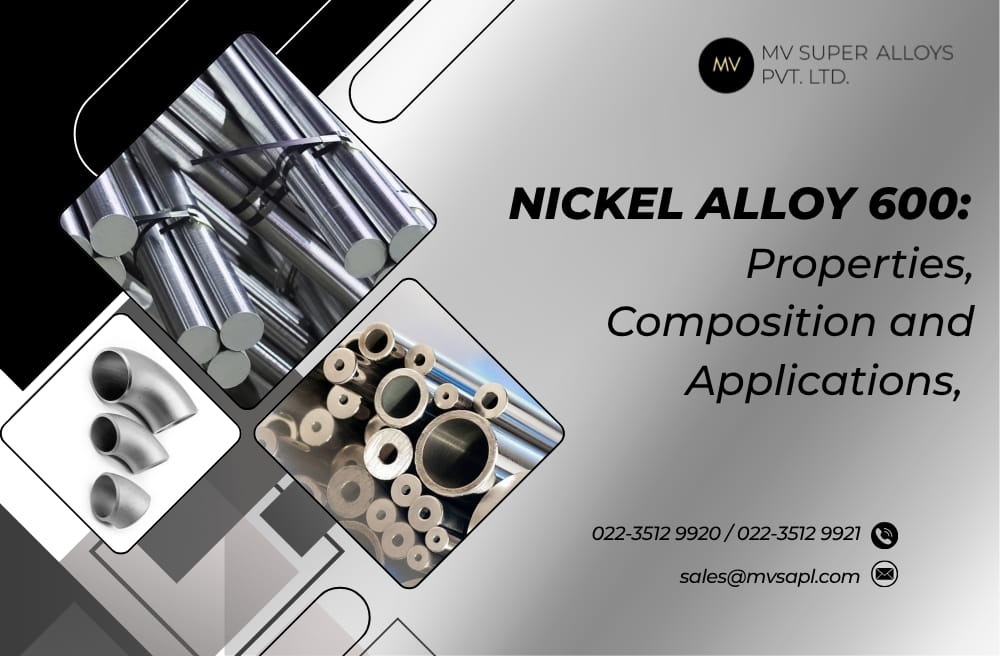
Nickel Alloy 600: Properties, Composition and Applications
Nickel alloys find extensive use in industries that require corrosion resistance, high temperature strength and durability. Nickel Alloy 600 is one of the most diverse materials that are employed in harsh industrial conditions. In chemical processing industries, heat treatment machinery, and other applications, this alloy has remarkable resistance to oxidation and corrosion coupled with high temperature strength.
The industries that seek high-performance materials that can be relied on usually purchase products of a reputable Nickel Alloy 600 Exporter to guarantee quality and international standards. This blog presented by us at MV Superalloys is going to discuss Nickel Alloy 600 composition, its properties, and the most important areas that the alloy is important.
Nickel Alloy 600 What Is It?
Inconel 600 or Nickel Alloy 600 is a nickel-chromium alloy used in areas where there is high resistance to oxidation, corrosion, and heat as well. It is grouped as an Alloy 600 high temperature alloy, that is, it can be subjected to high temperatures without losing its mechanical strength or structural integrity.
The distinctive chemical make-up of the alloy gives it excellent resistance to a broad scope of corrosive media such as organic acid, alkaline or chloride. Due to these features, it is commonly applied in chemical processing, aerospace, nuclear power and heat treatment industries.
Nickel Alloy 600 Composition
The knowledge of the Nickel Alloy 600 composition assists in understanding why the material is so effective in extreme environments. The alloy is mainly made of nickel, chromium and iron with traces of other elements.
Common chemical composition:
Nickel (Ni): 72% minimum
Chromium (Cr): 14% – 17%
Iron (Fe): 6% – 10%
Manganese (Mn): Maximum 1%
Carbon (C): Maximum 0.15%
Silicon (Si): Maximum 0.5%
Copper (Cu): Maximum 0.5%
Nickel is very resistant to corrosion and is strong at high temperatures. Chromium has increased oxidation resistance whereas iron has increased structural stability and has been found to be cheaper without performance deterioration.
Such a balanced structure renders Nickel Alloy 600 applicable in applications where high temperature exposure is required as well as the corrosive environment.
Nickel Alloy 600 has major properties as discussed below.
Nickel Alloy 600 is characterized by outstanding mechanical and chemical characteristics. These characteristics have made it a material of choice in industries that need durable performance even in the face of harsh conditions.
1. Excellent Corrosion Resistance
Nickel Alloy 600 is very resistant to a large range of corrosive conditions such as organic acids, alkaline solutions and chloride ions. This is among the reasons why applications of Nickel Alloy 600 in the chemical industry are so rampant.
2. High Temperature Strength
Being an Alloy 600 high temperature alloy, it can be utilized at both cryogenic temperatures to about 1093 C (2000 F). It does not lose its mechanical properties at elevated temperatures.
3. Oxidation Resistance
The alloy has chromium content that assists in the formation of a protective oxide layer on the surface to inhibit oxidation in high temperature exposure.
4. Excellent Mechanical Strength
Nickel Alloy 600 is a material that has a high tensile strength and fatigue resistance. This renders it appropriate to elements that are subjected to mechanical strain and thermal cycling.
5. Good Weldability and Fabrication.
Conventional welding and machining methods can be used to fabricate the alloy with ease. This enables the manufacturers to manufacture pipes, tubes, plates, fittings, and fasteners among other industrial applications.
Nickel Alloy 600 Uses:
Due to its multifarious characteristics, Nickel Alloy 600 finds application in a number of industries. Firms usually depend on a registered Nickel Alloy 600 Exporter to provide superior materials to be used in projects of utmost importance.
Some of the key industries that utilize this alloy in large amounts are listed below.
1. Chemical Processing Industry
Among the numerous uses of Nickel Alloy 600 in the chemical industry is the manufacture of equipment used to handle corrosive chemicals.
Common applications include:
- Heat exchangers
- Reaction vessels
- Chemical processing equipment
- Evaporators and condensers
It is corrosion-resistant and therefore it is suited to working with acids and alkali solutions.
2. Heat Treatment Industry
Nickel Alloy 600 is a material that is frequently employed in heat treatment furnaces because it does not deform at high temperature.
Typical components include:
- Furnace rollers
- Retorts
- Heat treating baskets
- Thermocouple protection tubes
It is also a good high temperature Alloy 600 that is stable at high temperatures and can be used in such applications.
3. Aerospace Industry
The materials should have high stress and temperature endurance in the aerospace application. Nickel Alloy 600 is used in:
- Jet engine components
- Exhaust systems
- Aircraft ducting systems
It is a mixture of heat-resistant and mechanical strength thus suited to the aerospace environment.
4. Nuclear Power Industry
It is commonly used in nuclear power plants due to the characteristics of nickel Alloy 600 which resist corrosion and high temperature water.
Applications include:
- Steam generator tubing
- Nuclear reactor components
- Control rod mechanisms
The stability and longevity of the alloy facilitates safety and dependability in nuclear plants.5. Electronics and Electrical Industry.
Nickel Alloy 600 is also used in electrical engineering as it is good in oxidation and temperature resistance.
5. Typical applications include:
- Electrical heating elements
- Resistance wires
- Electronic components in the heat.
The advantages of the alloy in these applications include long life and consistent service of the alloy.
The advantages of Sourcing a Trustworthy Nickel Alloy 600 Exporter.
Quality and certification are very crucial when using materials in critical industrial applications. A reliable Nickel Alloy 600 Exporter like MV Superalloys also makes sure that the alloy is of international standards like ASTM, ASME and DIN.
Benefits include:
- Assured chemical composition and mechanical qualities.
- Adherence to international standards of quality.
- Multifunctional availability in the form of plates, pipes, bars, and fittings.
- Regular supply of large industrial projects.
A supplier with experience will also mean that the material would work well in harsh conditions.
Nickel Alloy 600 is a very diverse material that has a great deal of corrosion resistance, high temperature strength and durability. It has a balanced Nickel Alloy 600 composition that enables it to work in the harsh environment in which most other materials fail.
Being an Alloy 600 high temperature alloy, it finds extensive application in chemical processing, aerospace and nuclear power, and heat treatment industries. The widespread applications of Nickel Alloy 600 in the chemical industry are additional testimonies of how this material can resist ruthless chemicals and elevated temperatures of operations.
FAQ for Nickel Alloy 600
1. What is Nickel Alloy 600 used for?
Nickel Alloy 600 is used in industries such as chemical processing, aerospace, nuclear power, and heat treatment due to its excellent corrosion resistance and high temperature strength.
2. What is the Nickel Alloy 600 composition?
The Nickel Alloy 600 composition mainly includes Nickel (72% minimum), Chromium (14–17%), Iron (6–10%), and small amounts of manganese, silicon, carbon, and copper.
3. Why is Alloy 600 considered a high temperature alloy?
Alloy 600 high temperature alloy classification comes from its ability to maintain strength and oxidation resistance at temperatures up to about 1093°C (2000°F).
4. What are the Nickel Alloy 600 used in the chemical industry?
Nickel Alloy 600 uses in the chemical industry include heat exchangers, reaction vessels, evaporators, condensers, and chemical processing equipment handling corrosive substances.
5. Why choose a Nickel Alloy 600 Exporter?
A certified Nickel Alloy 600 Exporter ensures high-quality material that meets international standards, offering reliable performance in demanding industrial applications.
About Post Author
